
In a just system, there’s a point where misconduct catches up with a public servant—especially when that public servant wears a badge, carries a gun, and swears an oath to protect.
For former New Rochelle police officer Lane Schlesinger, that point came and went. Repeatedly. And still, nothing was done.
FOIL disclosures obtained by The Republic Dispatch reveal a detailed, multi-year paper trail of internal misconduct reports, sustained complaints, and formal referrals to the New York Attorney General’s Office—all pointing to a dangerous and dishonest officer who should have been removed long before retirement.
He wasn’t. He was protected. And now the paper trail tells us why.
A Career Stained by Complaints—And Shielded by Silence
Lane Schlesinger wasn’t just disliked. He was repeatedly investigated by his own department, flagged by internal supervisors, and reported to the state for a growing list of infractions:
- Failing to activate or upload body-worn camera (BWC) footage
- Refusing to report or log traffic stops and use-of-force incidents
- Engaging in confrontational, politically charged, and disrespectful behavior during interactions with the public
- Submitting incomplete, contradictory, or inaccurate arrest reports
- Exhibiting a pattern of insubordination and policy defiance
In normal circumstances, any one of these might warrant discipline. Schlesinger racked up all of them—and more.
The Lieutenant Who Blew the Whistle
Beginning in 2021, then–Lieutenant Robert Wenzler of the New Rochelle Police Department began filing formal reports documenting Schlesinger’s behavior and escalating concerns about his fitness for duty.
FOIL documents include at least five formal referrals to the Law Enforcement Misconduct Investigative Office (LEIMIO)—the oversight unit within the Office of the New York Attorney General established under Executive Law § 75.
These weren’t vague complaints.
Each referral included:
- Specific policy violations
- Witness statements
- Internal correspondence
- Body camera issues
- Examples of dishonest or unprofessional conduct
One memo, dated October 2022, states that Schlesinger was no longer permitted to perform any public-facing roles, testify in court, or represent the department in any official capacity.
At that point, NRPD effectively recognized that Schlesinger could no longer be trusted—not with the public, not in court, and not with the truth.
The COVID Incident That Should Have Triggered Termination
Among the reports sent to the AG was Schlesinger’s now-infamous 2021 hospital incident, where he entered a COVID-19 ICU ward without a mask, shouted at hospital staff, and triggered a 911 call. FOIL records confirm that hospital security formally documented the incident, and Lt. Wenzler referred it to LEIMIO.
No action was taken.
No charges were filed.
No internal discipline occurred.
When The Republic Dispatch reviewed the AG’s May 24, 2024 “pattern misconduct” report, the hospital incident—and at least two other referrals from 2023—were nowhere to be found.
Emails Reveal a Wall of Bureaucratic Inaction
In one email dated February 2023, Lt. Wenzler followed up with state officials after weeks of silence on multiple referrals. He reiterated his concern that Schlesinger’s behavior posed a public safety risk and that disciplinary inaction was undermining morale and credibility within NRPD.
Still—no reply.
Still—no investigation outcome.
Still—no accountability.
By early 2024, Schlesinger quietly retired, pension fully intact, with no formal findings of misconduct ever made public.
A Case Study in Oversight Failure
This was not a case of “no one knowing.”
This was a case of everyone knowing—and no one acting.
- The department knew.
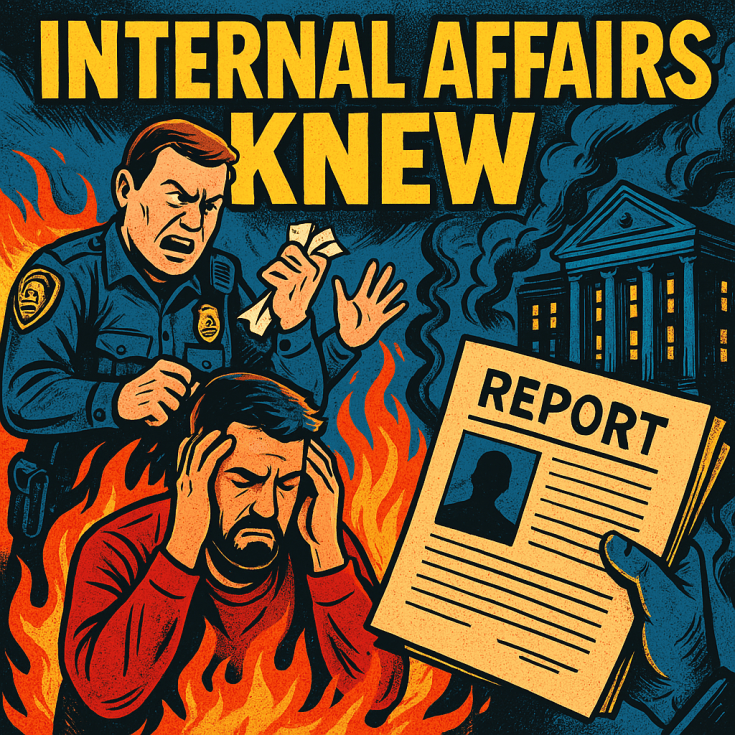
- Internal Affairs knew.
- The Attorney General’s office knew.
- And every level of government let it slide.
The system had every opportunity to prevent further harm. Instead, it insulated a known liar, allowed him to fabricate arrests, and protected him long enough for him to escape public consequences.
Meanwhile, a Father Suffers
Among the many victims of Schlesinger’s misconduct is Marc Fishman, a disabled father arrested by Schlesinger in 2018. His case included:
- A falsified police report
- Withheld exculpatory video evidence
- A court-acknowledged supervisor that invalidated the arrest
- A permanent order of protection based on falsehoods
Despite multiple AG referrals about the same officer, Marc’s conviction has never been vacated.
Conclusion: Who Will Be Held Accountable?
The paper trail exists. It has names, dates, facts, and a consistent theme: Schlesinger was dangerous, dishonest, and protected at every level.
The question is no longer whether internal affairs knew.
The question is why they let him stay on the street for so long—and why no one, not even the New York Attorney General’s office, acted before more lives were damaged.
Call to Action:
If internal affairs can’t act and state oversight won’t, then it’s time for federal civil rights investigators, independent commissions, and public exposure to do the job instead.
Discover more from RIPTIDE
Subscribe to get the latest posts sent to your email.


